
Rand Paul and Percy Sledge
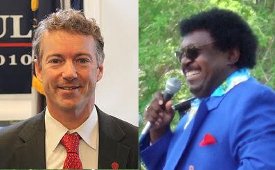 I enjoy my frequent visits to rural Kentucky. Only five hours from my home in Charlotte, NC, I enjoy the openness that the countryside affords. I have family there who in turn have other friends and extended family.
Recently I visited a small town celebration, complete with roped-off streets, sidewalk vendors and free outdoor concerts at night. Although a generally white populated area, I enjoyed — would you believe — Percy Sledge, the black soul musician still going strong at 70 years old.
For me, the concert was both delightful and surreal.
I first heard Percy perform his “When a Man Loves a Woman” when he was in his early twenties, and I in my late teens.
It was around 1964 in a yet racially segregated city in North Carolina. The famous federal court-ordered forced-busing school desegregation plan which began with Charlotte was years away. Many restaurants, movie theaters and swimming pools were by continued practice, closed to black citizens. The ink on the Civil Rights Act of 1964 was still wet, with many people of color fearful of long-held biases, still vulnerable to insults by white shop owners.
My city had been more progressive than other southern cities, yet tension was palpable. Separate restrooms, water coolers and the like had been removed, of course, but neighborhoods were still legally segregated. Fair-housing legislation would not come for another three years.
It’s been a long road, I thought to myself, as Percy finished his set. In his mostly white audience I was once again reminded that these soul and Motown artists of the 50’s and 60’s had broken the race barrier long before appropriate laws could be enacted.
The rural town in which I was visiting is hospitable and inviting. Its school system is excellent, well-equipped and well-staffed — a source of great pride and opportunity.
Yet there is a bit of a disconnect. I sensed it last year when parents and some teachers were opting not to allow children to view the speech which the president had designed especially for them. (To be fair, although Charlotte schools built the speech into their lesson plans, some North Carolina school systems provided alternative activities for students whose parents did not want their children to view the president’s speech. And school systems in some other states flatly closed their doors to the president.)
It also was clear that I was in “Rand Paul country.” I watched with interest as fresh Rand Paul for Senate campaign signs were being distributed among young campaign workers.
I thought immediately of candidate Paul’s ambivalence toward the Civil Rights Act of 1964. As a libertarian (not simply a Republican like the one he defeated in the primary) Paul has little use for state governments, and even less for the Federal government, generally opting for state government as the lesser of two evils.
Ideologically, he could not find justification of a federal civil rights act yet he agreed that racism is wrong.
As I watched the campaign signs being moved from one part of town to another, I think I got it, sort of. In so many ways this little town surrounded by family farms and nurseries is light years away from the happenings of Washington, DC. Culturally, our capital has little influence or affinity with this part of the country. The attitude of the locals, I believe, is to keep it that way.
Thus candidate Paul. With his “little-to-no-government” political orientation, these Kentuckians feel very secure. If elected, they are not really sending him to do anything, but rather to not do anything. This is different than doing nothing, as counter-intuitive as that might sound. They clearly want him to lessen whatever effect upon them the federal government might have. And that, in the view of his constituency would be an accomplishment.
So Mr. Paul has something of a local hero status. He is the statement from these proud folks that “We’re doing just fine without you, but thank you just the same.”
If my insights are correct, then this little town is a lot like my hometown of Charlotte when I was a boy, before the banks, the buildings, and professional sports came to town. The nostalgic part of me is quite comfortable with Rand Paul’s “Just Leave Us Alone” approach to government. In some idealistic way it makes sense.
Well, except for one thing. If I knew Percy Sledge personally, I’d love be able to invite him out for some North Carolina barbecue.
Without the federal civil rights legislation of the 1960’s and 70’s, I’m not sure in which of our fifty states that would be legal.
Still, my sense is that, assuming that he didn’t mind putting up with the reflections of two older dudes, Rand Paul would enjoy eating with us.
Comments
Rand Paul and Percy Sledge — No Comments
HTML tags allowed in your comment: <a href="" title=""> <abbr title=""> <acronym title=""> <b> <blockquote cite=""> <cite> <code> <del datetime=""> <em> <i> <q cite=""> <s> <strike> <strong>