
Human Littering
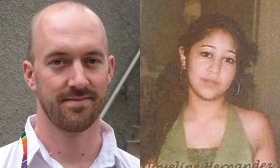
Dan Millis - Josseline Hernandez
It was back in February of 2008, the 22nd to be exact, when two U.S. Fish and Wildlife Service officers intervened.
The perpetrator had been collecting trash from the Arizona desert.
The irony, according to Julianne Hing writing for the ColorLines news blog, was that the officers did not take the trash but instead charged him with littering.
The ever vigilant Wildlife officers did not leave empty handed, confiscating the 22 one-gallon plastic bottles of water which Millis had planned to leave for migrants that day. The infraction was not all that serious, and could easily be resolved by paying a small fine.
However, Dan Millis, a volunteer with the humanitarian aid group No More Deaths refused to pay the $125 ticket, forcing a conviction which would result in a $5,000 fine and six months in jail. Millis appealed the verdict and nearly two years later the Ninth Circuit overturned his conviction.
Two of the three judges hearing the appeal refused to equate plastic water bottles with the statute’s “dumping of waste” prohibition, choosing to interpret the anti-littering law as an anti-garbage law. The dissenting judge, however, would have put Millis in jail and exacted the $5,000 fine. After all, litter is litter.
There is a reason that Dan Millis was willing to face conviction, in order to keep this matter before the public.
Just two days prior to his encounter with the wildlife officers, Millis had also discovered the body of Josseline Jamileth Hernandez Quinteros. The 14-year-old Salvadoran girl had been left behind when she could no longer tolerate the desert winter’s intense conditions. The coyote in charge promised her ten year old brother that someone would find and help his older sister who was trying to reunite with their mom in Los Angeles.
Weak and dehydrating from intense nausea, she was alone in the desert for weeks before Millis found her, yet too late to help.
Within the two years between Millis’ initial citation and his ultimate victory in Appeals Court, over 250 additional bodies were found in the Tucson Border Patrol sector. However there are many more, according to the No More Deaths website,
FY2010 was a record for migrant deaths, which continue to rise due to growing border enforcement. For every one of these remains found and recorded, there are dozens more that go unfound—leaving scores of families without knowledge of their loved ones.
Millis is not the only person to be prosecuted for littering the Arizona desert with life-saving supplies, and was actually more fortunate that others.
In recent years, multiple border activists have been cited for littering by the Fish and Wildlife officers. In June 2009, a federal jury convicted another activist on a similar littering charge. No More Deaths activist Walt Staton was sentenced to 300 hours of community service and a year of probation.
Millis’ victory probably feels a bit hollow. Jullianne Hing’s article explains:
Millis said that his defense, led by Arizona attorney Bill Walker, was forbidden to mention in court why he was out there in the first place, and why No More Deaths does its work. Millis was forced to argue his case without what he called a necessity defense.
However, Millis and his No More Deaths fellow volunteers can site a higher authority for their actions.
And if anyone gives even a cup of cold water to one of these little ones who is my disciple, truly I tell you, that person will certainly not lose their reward.” Matthew 10:42
When Dan Millis first saw the green shoes he thought that their owner was close but hiding.
He began calling out the standard No More Deaths chant, designed to reassure fearful migrants. “¡Hola, hermanos! Somos amigos de la iglesia. Tenemos comida y agua.” Hello, brothers or sisters! We’re friends from the church. We have food and water.
–from The Death of Josseline: Immigration Stories From the Arizona-Mexico Borderlands By Margaret Regan
But it was too late. Her remains would be taken to California where her mother would bury her.
Some time later, family members assembled at the rock in the desert where she had died. A priest, Father Bob, would join them for a special service and would anoint a cross with oil, a pretty pink and white cross painted with flowers and decorated with ribbons courtesy of the Phoenix chapter of No More Deaths.
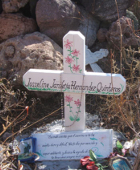 Assuming that the cross was allowed to remain in the desert, others will read the poem of encouragement written by a distraught mom, translated as follows:
“When you feel that the road has turned hard and difficult / Don’t give yourself up as lost / Continue forward and seek God’s help.”
In many Hispanic cultures and countries, one does not trust in law which is often applied unfairly if not corruptly. However, one can trust in God.
Jesus is called Jesucristo, to differentiate him from all those young Latinos who are named Jesús in his honor. Josseline Hernandez believed in this Jesus.
“Te llevaremos siempre en el corazón,” inscribed Josseline’s mom. “We will always carry you in our hearts.”
The United States with its obsession for border security believes in law, but seemingly would make the application of Jesus’ words into a crime, preferring the litter of human remains over plastic water bottles.
As I was researching this article, I often encountered negative and accusatory comments concerning this tragedy. One responder even went so far to suggest that the No More Deaths folks were somehow inciting more people to embark on these treacherous journeys.
The claim was made that the coyotes even used photos of water bottles in the desert to encourage reluctant prospects. I do not claim to know if that is true, or just a convenient retort. However, the coyotes are cruel and unscrupulous and are the most to blame for these terrible tragedies. I read one account of a coyote who contacted Josseline’s mom after her daughter’s death but before the final identification of the body, claiming that for a monetary payment he could find her daughter, allegedly still alive.
The coyotes will say whatever they need to say, grossly under-representing the difficulty of such trips across the desert. The humanitarian actions of the No More Deaths volunteers are not the cause of those desperate to make a better life for their families.